
Next-Generation of AI Systems to Run on an AI Operating Layer
Many businesses are beginning to think strategically about AI and laying out a plan to embrace it. Increasingly, they are realizing that they should stop thinking about AI as individual/siloed tools, and instead, begin designing AI operating architectures and build AI platforms that orchestrate intelligent systems at scale.
You may ask: Why does this matter? We all are aware that the percentage of autonomous AI agents that are capable of making decisions or executing tasks will continue to increase—Gartner puts this at 30% of enterprise application. As enterprises deploy AI agents across departments (for example, AI agents for automation, analytics, customer service, security operations, and development productivity, and so on), a new challenge is likely to emerge, that of agent sprawl. Without a coordinating architecture, these agents will operate in isolation, leading to fragmented systems and governance challenges
If businesses do move forward without centralized governance and orchestration, these systems (that is, autonomous AI agents) could introduce operational risk. It would, therefore, be wise for organizations to scale AI by embracing the notion of Enterprise AI Control Plane.
In the remainder of this blog, I would like to discuss the value that an Enterprise AI Control Plane architecture can bring to businesses and how it enables organizations to safely scale AI systems across the enterprise.
Senior Solutions Architect

Ravi Gaurav

Last updated Apr 15, 2026
The Persistent Problem of Silos
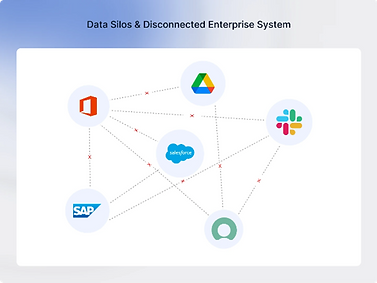
Although, AI adoption is on the rise across industries, most of these initiatives are still fragmented. The pattern is very familiar: different teams deploy AI application (for example, AI copilots, AI chatbots, data science models and automation tools) to address a specific problem. However, these tools rarely integrate with the broader enterprise architecture. Hence, most organizations end up with sprawled AI initiatives that look like this:

.png)
Each department tends to deploy its own AI capabilities. For example, the marketing department experiments with generative AI, the customer support department uses chatbots, IT teams deploy automation assistants, and data teams build machine learning models. The result? AI fragmentation.
The problems created by this approach to AI, include and not limited to:
-
Inconsistent governance
-
Duplicated models and infrastructure
-
Lack of policy enforcement
-
Security and data risks
-
Difficulty scaling AI across the enterprise
You may recall, these were also the challenges organizations faced in the early days of cloud adoption, and the cloud platform providers resolved them through a control plane architecture. It is time that AI follows the same path.
What is an Enterprise AI Control Plane
An Enterprise AI Control Plane acts as the central management layer for enterprise AI systems. This centralized orchestration layer coordinates the entire AI ecosystem across the enterprise. It sits above models, agents and enterprise systems, and ensures that the AI systems operate safely, consistently, and within the framework of defined policies.
Instead of allowing AI tools to operate independently, the Enterprise AI Control Plane manages:
-
AI models
-
agent orchestration
-
governance policies
-
identity and access control
-
observability
-
workflow integration
Key Capabilities of the AI Control Plane
1. Agent Discovery and Registry
Maintains a centralized inventory of all AI agents across the enterprise, providing visibility into agent capabilities, system access, and decision permissions. In mature enterprise environments, this registry also supports agent lifecycle management, including:
-
Agent versioning
-
Deployment pipelines
-
Testing and simulation environments
-
Kill switch and rollback capabilities
This ensures that AI agents are governed and managed with the same rigor as enterprise software systems.
2. Policy and Governance Enforcement:
Ensures AI agents follow enterprise policies including data access rules, compliance requirements, and audit logging.
3. Agent Collaboration via Agent Mesh:
Enables specialized AI agents to collaborate across workflows. Example:
-
Customer query → Customer Support Agent
-
Issue escalation → Incident Resolution Agent
-
Root cause analysis → Infrastructure Agent
-
Remediation → Automation Agent
4.Enterprise Observability: -
Provides monitoring for agent performance, model usage, anomalies, and operational costs.
5.Secure Data Interaction: Implements guardrails and policy enforcement to protect sensitive enterprise data accessed by AI agents.
Identity and Delegated Authority
In enterprise environments, AI agents frequently operate on behalf of users or enterprise services. The control plane therefore implements a clear identity model where agents act with explicit delegated authority and least-privilege access. This ensures that:
-
Agents inherit identity from a user or system service
-
Permissions are restricted to only the resources required
-
All agent actions remain auditable and traceable
This model ensures that AI systems operate securely within enterprise governance frameworks.
AI Control Plane Architecture
The Control Plane ensures that AI systems behave consistently across the organization.
In an enterprise agentic architecture, AI capabilities operate across multiple layers that together enable secure, scalable AI adoption. While agents execute tasks inside enterprise systems and interact with enterprise data, the Control Plane acts as the central governance and orchestration layer that ensures that these agents operate within defined enterprise policies.
At a high level, this architecture separates responsibilities across three key layers. The Control Plane governs policies, identity, orchestration, and observability. The Data Plane provides access to enterprise data, grounding context, and knowledge retrieval required by AI agents. The Execution Plane is where agents perform actions within enterprise systems and workflows.
This layered architecture allows organizations to scale AI safely while maintaining governance, security, and operational visibility across the enterprise.

Rise of the Agent Mesh
As enterprises move toward AI-driven automation, a new architecture pattern is emerging. Instead of single AI systems, organizations will deploy networks of AI agents that collaborate across workflows.
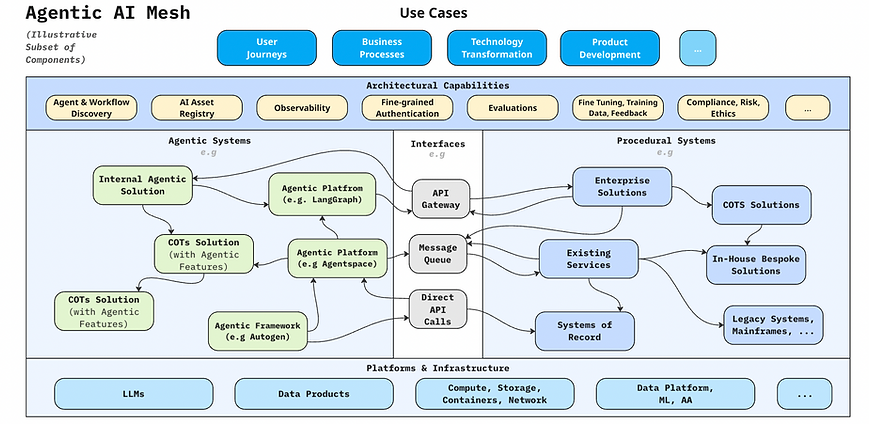
In this model:
-
Specialized agents perform specific tasks
-
Agents communicate through orchestration layers
-
Decisions are coordinated across systems
Examples include:
-
Incident resolution agents
-
Service desk copilots
-
Financial analytics agents
-
Security monitoring agents
The AI Control Plane coordinates this entire ecosystem.
Concrete Value Through the AI Control Plane
If organizations adopt an Enterprise AI Control Plane with an Agent Mesh architecture, they are likely to see the following types of measurable outcomes:
-
Approximately 30–45% reduction in operational workload
AI agents can automate repetitive operational tasks across IT, customer service, and enterprise workflows. Research from McKinsey & Company shows AI-driven automation can significantly reduce manual operational effort.
-
Up to 40 percent faster incident resolution (MTTR)
When AI agents analyze events, telemetry, and logs in real time, organizations can detect and remediate issues faster. Gartner reports that AIOps driven operations can reduce incident resolution time by up to 40 percent.
-
Up to 30 percent improvement in operational efficiency
Coordinated AI agents across enterprise workflows enable faster decision making and process optimization.
-
Up to 35 percent improvement in AI program efficiency
A centralized AI control plane prevents duplicated models, unmanaged AI deployments, and fragmented governance. Research from Deloitte shows organizations with centralized AI governance frameworks improve AI program efficiency significantly.
-
Improved enterprise AI governance and compliance
A control plane ensures policy enforcement, auditability, model monitoring, and secure access to enterprise data across all AI agents.
-
Scalable enterprise AI adoption
Instead of isolated AI pilots, organizations can deploy coordinated AI agents across departments such as IT operations, security, customer service, and finance.
-
Foundation for AIOps driven enterprise operations
By orchestrating AI agents across workflows, enterprises can move toward predictive operations, intelligent automation, and autonomous remediation.